Showing posts with label Tom Luddy. Show all posts

Tuesday, April 4, 2017

Gennady Shpalikov's A LONG AND HAPPY LIFE and the Mel Novikoff Award for TOM LUDDY

Tom Luddy

My friend and long-time mentor in film arts Tom Luddy is receiving the coveted Mel Novikoff Award st the SF Film Festival on April 9 at the Castro Theater in San Francisco. Luddy, a co-director of the Telluride Film Festival, has been associated with American Zoetrope since 1979. Join SFFILM Festival for this program (4 PM) featuring a conversation with Tom followed by Tom's choice of two films: a rarely screened Godard short and Gennady Shpalikov's landmark A Long and Happy Life (1966).


Gennady Shpalikov's A Long Happy Life (1966)

Kiril Lavrov and Inna Gulaya in A Long and Happy Life
See the trailer here

In the history of Russian, perhaps, even European auteur cinema, “A Long Happy Life” (1966) is unique. Now a classic, this autumnal drama of love and disenchantment (with strong autobiographical overtones) marks the debut of Gennady Shpalikov’s career as director. It also marks its end. Acclaimed abroad but barely appreciated in Russia, he was never allowed to direct another film, even though he continued to write for the screen until his suicide in 1974 at the age of thirty-seven.

Inna Gulaya and Gennady Spalikov

The film begins on a fall Saturday, at dusk at a construction site outside Novosibirsk. A group of young men and women – the beautiful Lena (Inna Gulaya, Shpalikov's wife) among them – are boarding a factory bus at dusk for a long ride to the big city to catch the Moscow Art Theatre production of Anton Chekhov’s The Cherry Orchard. Half-way there and after night fall, they pick up a hitch-hiker Victor (Kirill Lavrov), who takes the seat next to Lena. A geologist with a roving eye, Victor, who is in his early thirties, is making his way home in European Russia; Lena, in her early twenties, is beautiful, naïve, and dreamy.

Inna Gulaya in A Long and Happy Life

They “click.” Before long, they exchange confidences about their childhoods. Lena remembers her heart break from a crush on a fireman; her flashback is the film’s first homage to Jean Vigo’s “L’Atalante.”

A Long and Happy Life
Jean Vigo, L'Atalante (1934)

What began as a bus ride flirtation ascends to dizzying heights in the theater. Emotions swell against the dialogue of the two last acts of Chekhov’s play and intensify in the intermission, set up as a social mixer, replete with drinks and dancing in the foyer. Unable to resist, the two soon retreat into the dark recesses of the theater house and begin to kiss.


But it is not their embraces but their dialogue after they leave the theater that marks the emotional high point of their relationship: poetic chatter of a young couple in love, interspersed with mutual declarations of undying love and everlasting loyalty. 

The mood changes in the bleak light of the following morning. Lena, a modest suitcase in hand and an eight-year-old daughter in tow, rouses the hung-over Victor from his bed in a riverside floating guest house. She is ready to begin a “long and happy life” together.


What follows is a painful denouement terminating in a drawn-out coda (another tribute to Vigo’s Le Chaland qui passé, a.k.a., L'Atalante): a barge floating down the great Siberian river Ob. The film's soundtrack (composer Vyacheslav Ovchinnkov) ends on a pure accordion melody, reminiscent of L’Atalante’s closing tune.

Elena Chernaya, A Long and Happy Life

Like all gifted artists, Shpalikov was in a dialogue with his great predecessors and contemporaries. An admirer of Jean Vigo’s L’Atalante he turns Vigo's cinematic fairy tale about simple bargemen who live happily ever after into its opposite—a Chekhovian drama about the solipsism and narcissism of modern characters, amplified in the infinite echo chamber of the vast Eurasian plain.

A poet, Shpalikov, not unlike like Cocteau or Pasolini, was a master of subtle moods and resonances that fill the soul in moments of erotic intoxication or despair. A consummate master of monochromatic chiaroscuro, cinematographer Dmitry Meskhiev brought this poetry to life, encouraging the director to develop his own script, originally an ordinary melodrama, into a powerful existential cinema.


By grafting Chekhov’s pessimism onto sunny and irreverent Vigo and setting his action in the haunting dusk and darkness of Siberia, Shpalikov seems to have also produced a Russian take on the archetypal road film, Fellini’s La Strada, with his wife Inna Gulaya assuming the role of Gelsomina—in her husband's art, as in life (she is rumored to have died of an overdose in 1990).

Lena's childhood flashback. A Long and Happy Life.

Gelsomina (Giulietta Masina) in La Strada

For many in Russia, A Long and Happy Life marked the closure of the 'Thaw" cinema that flourished in the Soviet Union during the years of reform following Stalin's death.

* * *

Plays with Une bonne à tout faire (Jean-Luc Godard, 8 min, 1981/2006), a rare short filmed at Coppola’s American Zoetrope and revolving around a tableau vivant of a Georges de La Tour painting.
Not to be missed!

— Grisha Freidin

For tickets, click here.

Tuesday, October 6, 2015

WINTER ON FIRE - Documentary about the Maidan Revolution of 2013-14

I was at the San Francisco showing of a fantastic new documentary about the Maidan revolution, "Winter on Fire" (dir. Evgeny Afineevsky), that was organized by Tom Luddy at the Dolby Labs building on Potrero.
This morning, I still feel overwhelmed by this film documenting the 94 days of protests provoked by President Yanukovioch reneging on his promise to proceed with European integration of Ukraine.
I have been in a revolution before, and I still vividly remember the three days I spent outside the White House in Moscow in August 1991 (and then some both there and the Kremlin). It felt like being plugged into some high energy field, being both bigger and smaller than usual, but most of all being connected to the other defenders of the White House, their energy flowing through me and mine, through them. I remember feeling totally incredulous as I realized I was standing in a line blocking a column of APC's coming right at us from the direction of Kalininsky Propekt...
Afineevsky managed to catch the spirit of this revolutionary moment -- the moment when a new consciousness is born, whether it is a new religion, a new society, or a new country. Those three days in August 1991 filled me with enough spirit of commitment to last for two decades, and there is some left even today. This is what Beethoven must have meant when he used Schiller's Ode to Joy: Sein umgeschlungen, Millionen... When I heard it afterwards, I felt for the first time that I knew what the chorus was singing about.
Of course, life is more complicated, and I am sure the Maidan revolution itself was more complicated, but the Big Spirit prevailed, and that is the focus of the film.
After the revolution, comes political drudgery of nation-building, the process that Max Weber called routinization of charisma: the hard work of transforming this transcendent spirit into functioning, orderly institutions of society and state. I hope Ukraine succeeds where Russia seems to have faltered.
"Winter on Fire" makes the Maidan revolution, perhaps, the first to be "crowd-documented" on video: from HD Canon cameras to iPads, iPhones, and just plain cell phones, some of them turned on and left running by the victims of riot police cracking their sculls open. It's all there in the film, edited into one big tsunami wave of revolutionary spirit washing over the Square.
I especially recommend the film to those people -- foremost among them, President Vladimir Putin - who think that the Maidan revolution was the result of the CIA or State Department or some other Western behind-the-scenes manipulation. I hope the film will change their mind. Needless to say, "Winter on Fire" is not the whole story. Because of the film's exclusive focus on the grass roots, it may not do justice to the contretemps among the leaders of the Maidan or some groups like the Right Sector, but the film shows beyond reasonable doubt that this was an authentic social movement of Ukrainian people -- at first, the Kiev student, then the cross-section of society -- that coalesced over three months and, paying the highest price in the dead and the wounded, overthrew the corrupt regime that had betrayed them.
There is still a lot of work to be done in Ukraine...

Please note: "Winter on Fire" is scheduled to premiere on Netflix on October 9. Here's a link to the trailer on Youtube.

Tuesday, September 27, 2011

Target: Film Screening and Discussion at Stanford University. Nov. 10, 6PM

Ever since posting my review of Target in March, I have been asked by readers where they could see the film. Here, at last, is the opportunity.


Screening of Target (2010), directed by Alexander Zeldovich, script by Vladimir Sorokin and Alexander Zeldovich.
Discussants: Alexander Zeldovich, Vladimir Sorokin, Gregory Freidin (Professor of Slavic Languages and Literatures, Stanford), Tom Luddy (Director, Telluride Film Festival) 

Date: Thursday, November 10, 6 PM.
Building 320 (Braun Corner), Room 105, in on the Main Quad of Stanford.

If you are closer to London than Stanford, you can catch Target at the BFI London Film Festival on October 25 and 26.

In the meantime, the film was recently screened at the Telluride Film Festival where it created quite a stir. The NYT critic A.O. Scott called it "an astonishing piece of visionary futurism" that left him in a state of a "sublime puzzlement" (NYT 9/5/2011). I hope this billing will elicit in some American distributors an equally sublime desire to show Target in the US.

Monday, April 18, 2011

Target, the Movie (Alexander Zeldovich and Vladimir Sorokin)

March 25. Berkeley


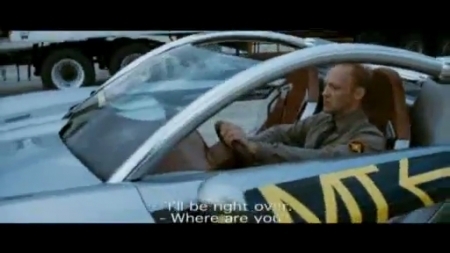
I saw The Target (Мишень) two nights ago (dir. Alxander Zeldovich, script by Alexander Zeldovich and Vladimir Sorokin. Ren Film, 2011). My friend Tom Luddy was kind enough to lend me a copy after he returned from the Berlin Film Festival where the The Target premiered.


The Target may be strong stuff for some but, I am not among them. For me, this is a visually grating (on purpose, of course) art-house film. Thought provoking? Yes, by the ton, and here is what it has provoked me into thinking.


I understand Vladimir Sorokin's thing, which Zeldovich chose to explore cinematically. It is to puncture the romantic illusion, whether the "good, true, and beautiful" of the 19th-cetury intelligentsia ideology or its later incarnations in socialist realism, and post-Stalin critical art and fiction (say, Solzhenitsyn). But if what you aim at is art, you cannot actually destroy illusion, because in art, illusion is indispensable. What ultimately happens when you try to do away with illusion is that you either stop producing art and have an analytical critique instead, or you simply replace one illusion with another, most likely, the opposite of your original target (pun intended). 

Let's consider the first possibility: The Target is a kind of an allegorical analysis of the human condition in the hydrocarbon-dependent and criminally corrupt Russia of the not-so-distant future. Those deluxe Russians, who have risen to the top of the pyramid and who think they are smart, beautiful and (this is the sci-fi twist, the dystopian part) entitled to eternal youth, are, in fact, ugly, stupid, and have a remarkable short life-expectancy. The sex scenes are abundant, in-your-face graphic, and telling - less fun to watch than a barn yard romance. 
They are Sorokin's version of an old school Russian literature teacher's question to an eighth-grade cretin.


The dialogue goes something like this: 
Tell me, Volodya, did Onegin really love Tatyana? 
Like, teach, I haven't like finished the book yet but I think he like just wanna hump her, you know, like a dog, like from behind...

What these Russian creatures call love, Sorokin and Zeldovich seem to be saying to us, is nothing but an animal urge, not even to procreate, though the central couple (an oil minister "Karenin" and his bored wife "Anna") are trying to conceive - need I say, unsuccessfully - but to dominate, to crush your partner. 

OK. We get the allegory: Putin's or Putin-Medvedev's Russia is nothing but a criminally corrupt enterprise that has no future or, rather, one like the present only slicker and bleaker than today. One of the male characters, played by Vitaly Kishchenko is a sex maniac mafioso and a biker (a "Vronsky" stud type), who looks suspiciously like Putin, especially as he rides his futuristic cruising bike or is transported to his death after his criminal enterprise crashes. 
Kishchenko and Zeldovich
To add a bit of complexity, the framing message is that USA is nowhere to be seen and the dominant cultural and everything else power is - you guessed it - China. There is an occasional Chinese face but, for the most part, the them is felt through Leonid Desyatnikov's minimalist score, with a bit of a Chinese musical lilt grafted onto it. A lot of people hold similar views, and as they watch this film, I imagine while checking email on their iphones, they may nod approvingly to having their thinking confirmed by the flickering screen.

But if we consider the second possibility, namely, that Zeldovich and Sorokin tried to make an art film (emphasis on art), then the result is a bust. What Target offers is an inverted romantic illusion. In our post-everything age, this means they are preaching to the converted. Indeed, it would be easier to find a snow ball in Hollywood than a potential member of the Target audience who considers the romantic illusion to be true (in a way that, say "money makes the world go round" is true).


My educated guess is that most people, nevertheless, find romance and romantic illusion pleasing. We like romance in the same way that the people who do not believe in Santa find Christmas trees pleasing. Ditto sex. We all know that sex, when seen by an uninvolved spectator, looks ugly - ugly enough, as Freud pointed out at length in The Wolfman, to traumatize a child for life (a Russian child no less!). But most would agree, our voyeuristic inclinations aside, that "doing it" is another matter. This is why the film's dis-illusion,  its attempt at disenchanting the magic of romance, makes for an unsuccessful artistic illusion. We already know: (1) "sex is ugly" and (2) life is ugly, too, not to mention brutish, short, and solitary. The author of Anna Karenina thought so following Hobbes, except unlike Hobbs, he thought that it was the state, not nature, that "made us do it." 
The art historian Ernst Gombrich once quipped that in engaging with art one can either immerse oneself in an the illusion induced by a work of art or subject it to a rational analysis; but it was impossible to "watch oneself having an illusion." The film Target by Zeldovich and Sorokin invite us to watch ourselves being disabused of the illusion that we do not have. 

And yet, the film is worth seeing. I was taken by a few scenes  that experts with a taste for Sots-Art, the post-modern legacy of the Stalinist aesthetic, may find amusing enough to endure the rest of the feature. The shots of the over-the-top affluence of the nouveau Russian country estates evokes the canvases extolling the abundance of Stalin's collective farms and the corresponding Stalinist celluloids. And the village that specializes in selling rejuvenation and life eternal looks suspiciously like Brat's native realm. So, there are a few worthy nuggets in dem da hills, even if it takes a bit of sweating and digging to get to them. A juxtaposition of another political heavy hitter, Balabanov's Cargo 200, and Target would make for an interesting essay (Balabanov's Putin-like biker Alexey Poluyan v Zeldovich's Putin-like biker Kishchenko)... As would juxtapositions of the film adaptations of the greatest nihilistic novel of all times, Oprah's favorite "Anna Karenina." I may actually show Target in class next year when I teach the novel.


PS. 9/5/11. Target has just been screened at the Telluride Film Festival. The NYT critic A.O. Scott called it "an astonishing piece of visionary futurism" and one that caused him to experience "sublime puzzlement." I hope this billing will elicit in some American distributors an equally sublime desire to show Target in the US. 


PPS. September 27, 2011. The film will be shown at Stanford, with a round table discussion to follow on November 10 at 6 pm (venue TBD). Discussants: Alexander Zeldovich, Vladimir Sorokin, Gregory Freidin (Professor of Slavic Languages and Literatures, Stanford), and Tom Luddy (Director, Telluride Film Festival).


Wednesday, January 26, 2011

“A Bitter Taste of Freedom” - How Sweet It Is!

Thanks to my friend Tom Luddy, the Director of the Telluride Film Festival, I had a pleasant surprise waiting for me in my mailbox on Sunday afternoon, “A Bitter Taste of Freedom” (2011), a cinematic biographical tribute to and about Anna Politkovskaya. The film was directed and, in part, shot by a much acclaimed Russian documentary film maker, Marina Goldovskaya, who had known and interviewed her subject personally. But it is not so much Anna Politkovskaya (much has been written about her) as the film itself that I am most interested in thinking about.

As we all know, a biographical tribute, documentary or otherwise, is always a mythology, because the materials are both selected and organized by the author—who always keeps one eye on the present, the moment that is shaped, among other things, by the outlook and interests of the author, whether they are acknowledged or not. "A Bitter Taste of Freedom" is no different in this respect from any other work of this kind. Two ostensibly historical lines frame its film narrative. One is Russia’s passage from perestroika to the fall of communism and, eventually, the Chechen war and the Putin presidency; the other is a personal story of Politkovskaya, her student years, her happy marriage to a man who became the center of the most daring and entertaining TV news program in the perestroika years, their eventual estrangement, divorce, and her professional rise in the late 1990s as an investigative journalist working for one of the few remaining independent news outlets, Novaya gazeta. Inside this frame is the strong and attractive, not to say beautiful, face of Anna Politkovskaya.

In a nutshell, “A Bitter Taste of Freedom” is a hagiography of a latter-day Russian martyr and, perhaps, a holy woman, and perhaps, even a saint. The voice over tells us more than once that the Chechen women – whose loved ones had been killed, tortured, or kidnapped by the Russian forces, and whose cause Politkovskaya fearlessly publicized ­– prayed to her.  Goldovskaya shows masterfully – and here she really hits the mark – what a charismatic person is about: intense and radiant with the sense of purpose and rectitude, wholly dedicated to her cause, and perhaps most important, vibrating with the sense of vocation. Charisma of course is the name of a type of social bond existing between the charismatic person and her followers, and Goldovskaya never tires of showing the worshipful admiration with which the Chechen women and others treated Politkovskaya. As a study in charismatic reporting, although it may not have been intended as such, the documentary wins high marks and will be worth studying in schools of journalism. 

There is also plenty of good footage from the 1980s to the present, along with a series of interviews of Anna Politkovskaya that the film maker had recorded over a course of several years (among them, a lot of close-ups of Politkovskaya being interviewed in her bathrobe in her hotel in LA, just before she rushed to Moscow to participate in negotiations with the terrorists who had seized a Moscow theatre).

Unintentionally, though, and most interesting for this writer, the film provides plenty of food for thought about the way that members of Russian intelligentsia, including Goldovskaya herself, look at the world through the prism of victimization: innocent victims of evil power who are redeemed symbolically in the acts and above all, death of a martyr-intercessor. There are other “habits of thought,” all too familiar to the students of Russian culture and society, for example, that Moscow equals Russia.  There is a long shot of the Moscow 1990 or 1991 march along Gorky Street meant to illustrate the real freedom enjoyed by Russian citizens that has now been lost under Putin. The sad truth is that Moscow, more exactly, the center of Moscow, is not Russia. I was in Moscow in the heady days of the August 1991 Putsch, and I remember being shocked by the routine normalcy of life just outside the small perimeter around the White House, not to mention outside Moscow or in other parts of the vast USSR, save St. Petersburg. This is probably the hardest truth for the Moscow intelligentsia elite to swallow (and has been for over a hundred and fifty years, at least since Alexander Herzen's acute observation on the subject, once he found himself in exile in provincial Russia). 

The context provided by the film leads the viewer into believing that it was by sheer transcendence that Politkovskaya managed to stand up to the Russian Leviathan. These intelligentsia elite optics cast Politkovskaya into a giant herself while Putin awkward explanation  (the unforgiving footage of his press conference in Prague) that the Kremlin had no rational motive for killing Politkovskaya, because her activities “had very little impact on Russian politics” begins to sound like a denial of a self-evident fact of Politkovskaya’s importance and, by an unspoken implication, of Putin’s complicity. Putin, of course, as well as those who might wish to please him by assassinating the Kremlin gadfly, the FSB, the Chechen Supremo Akhmad Kadyrov and his minions, have been mentioned in the press as possible conspirators. By the same token, though, their opponents had as much to gain from the assassination by embarrassing the authorities and showing how helpless these strongmen really were. Goldovskaya seems to be pointing her finger, though never explicitly, at Putin and nobody else. To the extent that Putin is where the proverbial buck stops, she has a point (for Politkovskaya, too, Putin was the ultimate evil genius) but given the fact that, pace Wikileaks, only 40% of Putin’s orders are ever followed up, it would have been only appropriate to mention other possibilities. 

What is, perhaps, most puzzling about the film is its actual voiding of history in favor of myth in its presentation of the turmoil in Chechnya, the main focus of Politkovskaya’s investigative journalism and, ipso facto, the documentary itself.  There is no mention that Yeltsin decision to send troops to Chechnya, however ill-fated, was a response to the civil war raging in Chechnya, de jure still under Russia's jurisdiction, in which Chechens had been killing Chechens and the central government had lost all control 1991-1994. Nor is there a single word about the apartment building bombings in Moscow in 1999 (and elsewhere) that preceded Putin's notorious "we'll look for the terrorists everywhere and we'll rub them out, and if we find them in the toilet, we'll rub them out in the toilet." Nor will anyone watching this film have any idea that Chechnya enjoyed a virtual independence in 1994-1999, with no central government presence in the republic itself, until Shamil Basayev (who had just resigned as Prime Minister of Chechnya), along with his Jordanian jihadist confrere Al-Khattab, led their Islamic International Peacekeeping Brigade <sic> into the neighboring Dagestan - de jure and de facto, part of the Russian Federation. In response to this act of aggression, Putin and Yeltsin, then still President, sent Russian forces back into Chechnya, beginning what is known as the Second Chechen War (1999-2006).

The brutality and atrocities perpetrated by the Russian troops in Chechnya are, of course, well-documented by human rights groups, journalists, foremost among them Anna Politkovskaya. But watching this film, you will learn little about the forces on the other side – those who chose violence, unleashing what is now a decade-long civil war in North Caucasus, whether in the name of independence of Chechnya or the establishment of the Caucasus Emirate, or joining the fight for the restoration of the Islamic Caliphate. What we see in the film are Chechen women weeping, mourning, pleading – and praying to their only savior Anna Politkovskaya. Even the seizure of a crowded Moscow theater (Nord-Ost) by a group of Chechen terrorists in 2002 that resulted in the death of one hundred and thirty  hostages, largely because of a botched rescue, is placed by the director at the feet of Vladimir Putin. True, he had apparently overseen the rescue himself and must bear the responsibility for his mistakes, but surely the blame should be with the terrorists, who threatened to blow up the theater and its nine hundred hostages and probably would have, had it not been for the rescue, botched or otherwise. For Goldovskaya, it seems, there is but one source of evil.

The film sounds a tragic note: a brilliant, fearless reporter, who took on a whole state establishment, is gunned down in the prime of her life. Paradoxically, though, it is this tragic note that sounds false, because in the end, “A Bitter Taste of Freedom” is a feel-good documentary: good people are on this, our side, the side of the good; the evil are on the other. Politkovskaya herself knew better:

 <…> all of us are responsible for what has been going on [in Russia]. The responsibility is ours above all, not Putin's. Our “kitchen” reaction to Putin (grumble about him over the kitchen table) and his cynical profanation of Russia – this is what made it possible for Putin to do what he had done to the country in the last four years. Political apathy shown by society is bottomless, and it is this apathy that has given Putin the pass to continue for four more years <treating the Russian people> like cattle…

(Putin’s Russia: Life in a Failing Democracy (2007); translation is mine from the Russian original)

Copyright © 2011 by gfreidin@stanford.edu