Showing posts with label Russia. Show all posts

Wednesday, December 14, 2011

In the Shadows of Ancestors, Invented and Forgotten. Two Recent Films from Russia

Ever wondered what happened to Oedipus? Look for the answer in two very different recent films from Russia, Silent Souls (Овсянки, dir. Alexei Fedorchenko) and I Will Remember (Буду помнить, dir. Vitalii Votobyev, 2010). Silent Souls will be screened publicly by the SF Film Society at the end of December 2011.

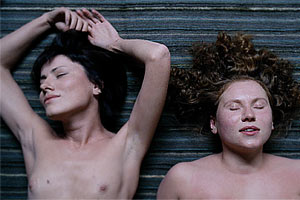
Silent Souls (Ovsyanki) could have been shot by Fellini if he had been exiled to northern Russia and denied access to Kodak color film but could lay his hands on some desaturated version of Agfa. It felt l was watching some Northern version of Amarcord or La strada. No wonder it received the best cinematography prize (camera work by Mikhail Krichman) at the Venice Film Festival and was among the top three favorites to receive the Lion d'Or that year. Director Aleksei Fedorchenko sets out to tell a story about a tribal identity, almost forgotten and practically invisible (possibly, totally invented),  yet concealing an ethnic difference as unsettling and relentlessly insistent – as a maddening itch between the toes of one’s amputated foot. 


Visually, Ovsaynki, with its mildly infernal leaden color scheme and wan faces of its protagonists, can be classified as   mournful elegy for a lost love,  composed in Hades. No sun shines there and, given the story, it is just as well. Most of the plot is deals with a bereaved husband and his friend driving an SUV, the body of the dead wife in the trunk. Their destination is a woodsy riverbank where the pair spent their honeymoon decades earlier and where now the husband plans to hold his wife's funeral — in accordance with some ancient custom, rooted in the archetypal recesses of his Finno-Ugric tribal memory.


But as you get deeper into the story, you begin to realize that “Silent Souls” is really a puzzle  about identity in the age of globalization. The main characters are two utterly average and average-looking middle-aged Russian guys. There is nothing special about them, except that they also happen to be descendants of an ancient Finnish tribe, by now almost completely forgotten, absorbed by ethnic Russians and their modern urban culture or, if you will, largely “globalized” out of existence. And yet, that ancient pre-modern world has left some of its tiny traces, still sufficient for reminding its descendents of their difference. Osip Mandelstam, writing about his largely secular childhood, observed that the family's Judaism, utterly vestigial, still reigned its odor: like musk oil, a tiny drop of it was sufficient to fill the whole house with its scent. Even less than a drop has survived of those ancient Finnish customs, and yet, we see that even a homeopathic quantity — a mere aura of the forgotten world — is capable of filling the space between the low-hanging, impenetrable cloud cover of the European north and its barren earth blanketed by sickly local flora where it has not yet been replaced by the anonymous twenty-first-century urban sprawl.

This is what makes “Silent Souls,” despite its ethnographic specificity, an allegory for the human condition of our age. The few ancestral traces that are left — names of rivers and odd fertility rites — are enough to create the urge to recover the rest but those who yield to it and  search search to recover some mythic plenitude wind up before a black hole and as happens to the two main characters, get sucked into nothingness. The sparrow-like birds (the Russian ovsyanki of the film’s original title) that “remind me of something that I seem to have forgotten” (the narrator’s words early in the film) turn out to be the harbingers, not of fertility (Aphrodite's sparrows), but death. There is, then, a calculated mythic inevitability about the plot: what the main character has “forgotten” and is trying to recall with the aid of the ritual turns out to be — the death wish itself.
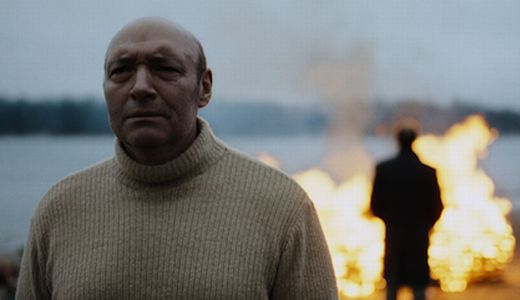

The story unfolds against the alternative world of an endless stream of cars on a superhighway and a “global” Japanese fast food in a shopping mall with its big box  retail outlets. As the two protagonists trek through some deadly large appliances section of a Russian Costco, you begin to feel a chill spread down your spine. No amount of casual sex with the odd-looking girls, who seem to have been sent from the northern branch of Federico Fellini’s central casting, can compensate for the emptiness of the discount shop plenitude.
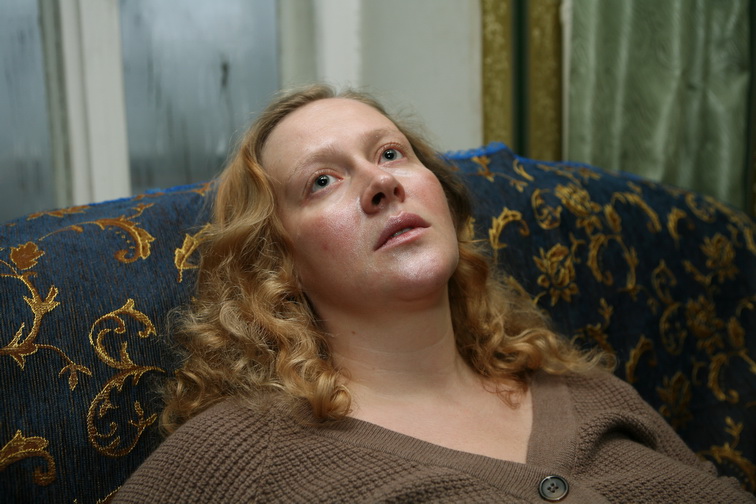

Fedorchenko seems to be offering us a moral: you can, if you wish, recover your lost identity – but only as you drive off the bridge into the Volga and join the world of the fish. This quiet despair about the human condition in the globalized world is what moved me deeply about this film. Fedorchenko shows people like us — twenty-first century, middle–class, educated — caught between the Scylla and Charybdes — between dissolving our identity in the globalized traffic flows of everything and trying to recover the imagined long-lost fullness of some communal, tribal life. If the movie is to be taken at face value, Odysseus was the last one to be able to steer clear of the two.

* * *

I Will Remember (Буду помнить), although not in the same league, is also about the "lost identity" nostalgia but of a completely different kind: a WWII melodrama that is good for your soul. The setting is Mineral Springs (Mineralnye body), a provincial town, a vacation spot, in the North Caucasus at the beginning of the war. The main protagonist is a an angry teenager, a Russian of Greek descent, who gets drawn against his will into helping a Russian boy of Jewish descent, a visitor form Leningrad, escape the holocaust after the Nazi invade his native town. If the color scheme in Silent Souls tends toward the mind-numbing leaden gray, I Will Remember dazzles with its gold, so warm and gentle that it could easily have been shot in Southern California. The golden glow has something to do with the nostalgic simplicity with which Russian tend to view the uncomplicated, if brutal, life in Stalin’s time. The erstwhile egalitarianism of poverty and the petty vanities of the petty ruling elite look refreshing — the Great Terror notwithstanding — to people used to the evermore rigid stratification and astronomical income inequalities of post-Soviet Russia. In the film, as the Soviet Army retreats from the town of Mineral Springs, Soviet order disintegrates and with it, the fabric of Soviet identities, revealing a society of far greater diversity in terms of class, ethnicity, religion, ethics, attitude towards the regime, and national commitment.

Remarkable for a film that appeals ostensibly to a wide audience (it may have been meant as a television movie), it reshuffles the deck of moral certitudes in such a way that even the evil characters gets to do good (a collaborator saved the protagonist who is about to be executed as a Jew) while the good ones, especially the boy’s father, can display bad judgment when faced with the choice between public weal, pleasing his boss, and the fate of his loved ones who depend on him for their survival.


One motif of the film is a handshake between the good and bad characters. Again and again, after a momentary hesitation, the hands are joined, as if in an allegory of an imperfect and ambiguous moral universe. The film clearly belongs to the age in which the necessity for moral compromise, at least a tactical one, is widely acknowledged. Such ethical sophistication is a far cry from the Russia of Tolstoy and Dostoevsky, let alone the Manichean ethics of the Soviet era. Not to belabor this point too much, though, in the film itself, justice triumphs, if imperfectly,  and the  family with the right moral instinct gets to have a future.


The two boys meet again in the epilogue, this time, as men in their seventies. If in Ovsyanki, the ordinary looking Russian men and women turn out to be, because of their ancestry,  anything but ordinary, in I will Remember, the difference between Jews and Christians, originally so stark, is completely erased. The film opens with a fight between the two boys, each infuriated with an insult to his ethnicity, but in  the epilogue, the Greek and the Jew, both in their hale seventies, meet again — one a well-known Russian author, the other an Israeli General — as if they were fraternal twins accidentally separated at a younger age.

* * *

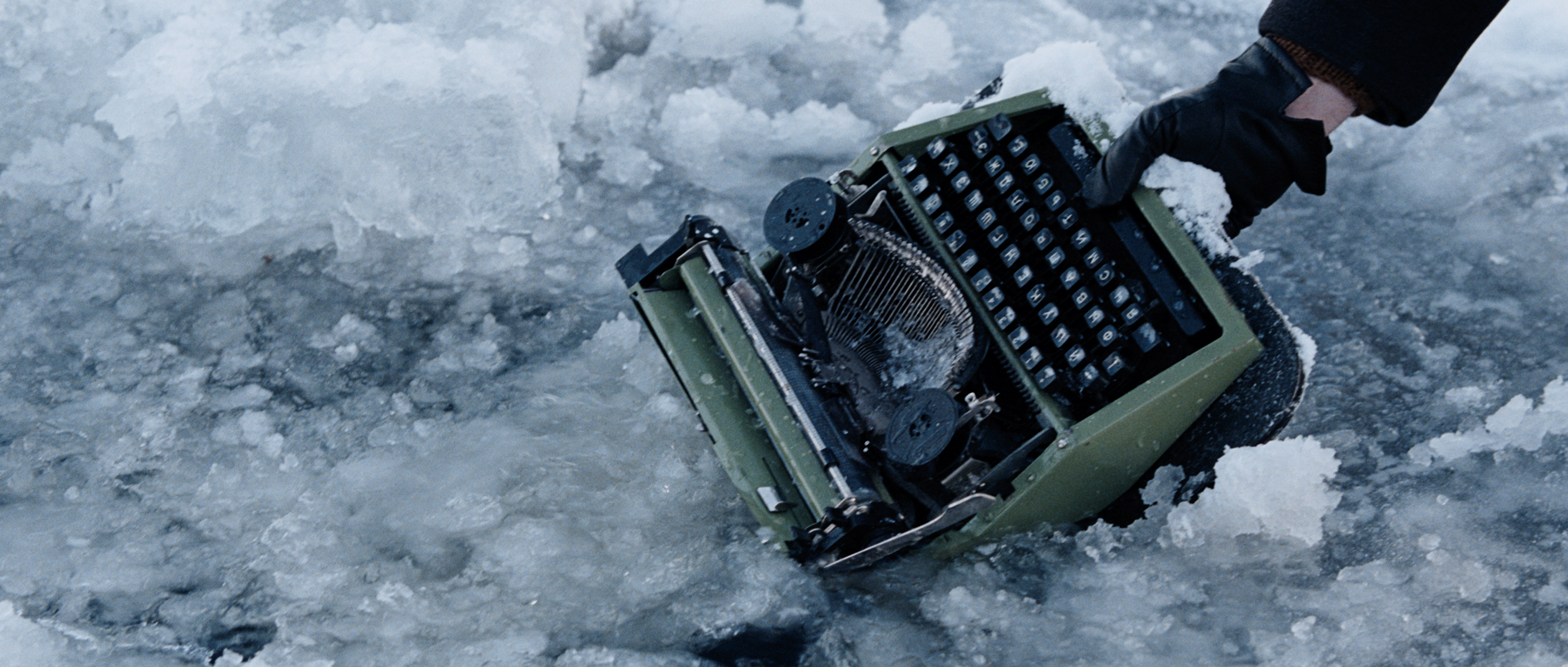
No story about men and boys  can remain neutral when it comes to the reenactment of the the myth of Oedipus. These two films are no exception, each tracing  its own Oedipal “paternal lineage.” In Ovsyanki, the Oedipal tension is barely noticeable: narrator, though baffled by his father’s literary ambitions (his old typewriter) ethnographic eccentricities and alcoholism (he died in a fiery car crash), carries on his late father’s ethnographic project and fulfills his father’s most cherished wish, death by drowning, considered a good death in the local tribal tradition. This is the kind of a resolution to the Oedipal drama that forecloses the future.

By contrast, I Will Remember, is the conventional Oedipus squared. The main protagonist has to deal with two father figures, his real mercurial father, who had spent time in the Gulag, and the surrogate one, who by hook or by crook, tries to win the affections of the boy’s mother. Both are killed by the boy: the natural father inadvertently and unintentionally, the surrogate one in what could have been a murder suicide but turned out to be just a murder. I Will Remember doubly reaffirms the natural order of generational succession and for that reason offers its viewers a promising future, even if a melodramatic one. Ovsyanky, by contrast, drowns the history of the Finnish tribe in the upper Volga in the riverrun of time, along with the narrator and his friend. Fedorchenko thus disposes of the last survivors of the endangered species still in thrall to their archetypal roots. As the Volga waters close over their heads, the endless stream of the highway traffic above keeps flowing on, and on...

Berkeley, October 2010 - December 2011
Copyright © 2011 by Grisha Freidin (gfreidin@stanford.edu)

Wednesday, January 26, 2011

“A Bitter Taste of Freedom” - How Sweet It Is!

Thanks to my friend Tom Luddy, the Director of the Telluride Film Festival, I had a pleasant surprise waiting for me in my mailbox on Sunday afternoon, “A Bitter Taste of Freedom” (2011), a cinematic biographical tribute to and about Anna Politkovskaya. The film was directed and, in part, shot by a much acclaimed Russian documentary film maker, Marina Goldovskaya, who had known and interviewed her subject personally. But it is not so much Anna Politkovskaya (much has been written about her) as the film itself that I am most interested in thinking about.

As we all know, a biographical tribute, documentary or otherwise, is always a mythology, because the materials are both selected and organized by the author—who always keeps one eye on the present, the moment that is shaped, among other things, by the outlook and interests of the author, whether they are acknowledged or not. "A Bitter Taste of Freedom" is no different in this respect from any other work of this kind. Two ostensibly historical lines frame its film narrative. One is Russia’s passage from perestroika to the fall of communism and, eventually, the Chechen war and the Putin presidency; the other is a personal story of Politkovskaya, her student years, her happy marriage to a man who became the center of the most daring and entertaining TV news program in the perestroika years, their eventual estrangement, divorce, and her professional rise in the late 1990s as an investigative journalist working for one of the few remaining independent news outlets, Novaya gazeta. Inside this frame is the strong and attractive, not to say beautiful, face of Anna Politkovskaya.

In a nutshell, “A Bitter Taste of Freedom” is a hagiography of a latter-day Russian martyr and, perhaps, a holy woman, and perhaps, even a saint. The voice over tells us more than once that the Chechen women – whose loved ones had been killed, tortured, or kidnapped by the Russian forces, and whose cause Politkovskaya fearlessly publicized ­– prayed to her.  Goldovskaya shows masterfully – and here she really hits the mark – what a charismatic person is about: intense and radiant with the sense of purpose and rectitude, wholly dedicated to her cause, and perhaps most important, vibrating with the sense of vocation. Charisma of course is the name of a type of social bond existing between the charismatic person and her followers, and Goldovskaya never tires of showing the worshipful admiration with which the Chechen women and others treated Politkovskaya. As a study in charismatic reporting, although it may not have been intended as such, the documentary wins high marks and will be worth studying in schools of journalism. 

There is also plenty of good footage from the 1980s to the present, along with a series of interviews of Anna Politkovskaya that the film maker had recorded over a course of several years (among them, a lot of close-ups of Politkovskaya being interviewed in her bathrobe in her hotel in LA, just before she rushed to Moscow to participate in negotiations with the terrorists who had seized a Moscow theatre).

Unintentionally, though, and most interesting for this writer, the film provides plenty of food for thought about the way that members of Russian intelligentsia, including Goldovskaya herself, look at the world through the prism of victimization: innocent victims of evil power who are redeemed symbolically in the acts and above all, death of a martyr-intercessor. There are other “habits of thought,” all too familiar to the students of Russian culture and society, for example, that Moscow equals Russia.  There is a long shot of the Moscow 1990 or 1991 march along Gorky Street meant to illustrate the real freedom enjoyed by Russian citizens that has now been lost under Putin. The sad truth is that Moscow, more exactly, the center of Moscow, is not Russia. I was in Moscow in the heady days of the August 1991 Putsch, and I remember being shocked by the routine normalcy of life just outside the small perimeter around the White House, not to mention outside Moscow or in other parts of the vast USSR, save St. Petersburg. This is probably the hardest truth for the Moscow intelligentsia elite to swallow (and has been for over a hundred and fifty years, at least since Alexander Herzen's acute observation on the subject, once he found himself in exile in provincial Russia). 

The context provided by the film leads the viewer into believing that it was by sheer transcendence that Politkovskaya managed to stand up to the Russian Leviathan. These intelligentsia elite optics cast Politkovskaya into a giant herself while Putin awkward explanation  (the unforgiving footage of his press conference in Prague) that the Kremlin had no rational motive for killing Politkovskaya, because her activities “had very little impact on Russian politics” begins to sound like a denial of a self-evident fact of Politkovskaya’s importance and, by an unspoken implication, of Putin’s complicity. Putin, of course, as well as those who might wish to please him by assassinating the Kremlin gadfly, the FSB, the Chechen Supremo Akhmad Kadyrov and his minions, have been mentioned in the press as possible conspirators. By the same token, though, their opponents had as much to gain from the assassination by embarrassing the authorities and showing how helpless these strongmen really were. Goldovskaya seems to be pointing her finger, though never explicitly, at Putin and nobody else. To the extent that Putin is where the proverbial buck stops, she has a point (for Politkovskaya, too, Putin was the ultimate evil genius) but given the fact that, pace Wikileaks, only 40% of Putin’s orders are ever followed up, it would have been only appropriate to mention other possibilities. 

What is, perhaps, most puzzling about the film is its actual voiding of history in favor of myth in its presentation of the turmoil in Chechnya, the main focus of Politkovskaya’s investigative journalism and, ipso facto, the documentary itself.  There is no mention that Yeltsin decision to send troops to Chechnya, however ill-fated, was a response to the civil war raging in Chechnya, de jure still under Russia's jurisdiction, in which Chechens had been killing Chechens and the central government had lost all control 1991-1994. Nor is there a single word about the apartment building bombings in Moscow in 1999 (and elsewhere) that preceded Putin's notorious "we'll look for the terrorists everywhere and we'll rub them out, and if we find them in the toilet, we'll rub them out in the toilet." Nor will anyone watching this film have any idea that Chechnya enjoyed a virtual independence in 1994-1999, with no central government presence in the republic itself, until Shamil Basayev (who had just resigned as Prime Minister of Chechnya), along with his Jordanian jihadist confrere Al-Khattab, led their Islamic International Peacekeeping Brigade <sic> into the neighboring Dagestan - de jure and de facto, part of the Russian Federation. In response to this act of aggression, Putin and Yeltsin, then still President, sent Russian forces back into Chechnya, beginning what is known as the Second Chechen War (1999-2006).

The brutality and atrocities perpetrated by the Russian troops in Chechnya are, of course, well-documented by human rights groups, journalists, foremost among them Anna Politkovskaya. But watching this film, you will learn little about the forces on the other side – those who chose violence, unleashing what is now a decade-long civil war in North Caucasus, whether in the name of independence of Chechnya or the establishment of the Caucasus Emirate, or joining the fight for the restoration of the Islamic Caliphate. What we see in the film are Chechen women weeping, mourning, pleading – and praying to their only savior Anna Politkovskaya. Even the seizure of a crowded Moscow theater (Nord-Ost) by a group of Chechen terrorists in 2002 that resulted in the death of one hundred and thirty  hostages, largely because of a botched rescue, is placed by the director at the feet of Vladimir Putin. True, he had apparently overseen the rescue himself and must bear the responsibility for his mistakes, but surely the blame should be with the terrorists, who threatened to blow up the theater and its nine hundred hostages and probably would have, had it not been for the rescue, botched or otherwise. For Goldovskaya, it seems, there is but one source of evil.

The film sounds a tragic note: a brilliant, fearless reporter, who took on a whole state establishment, is gunned down in the prime of her life. Paradoxically, though, it is this tragic note that sounds false, because in the end, “A Bitter Taste of Freedom” is a feel-good documentary: good people are on this, our side, the side of the good; the evil are on the other. Politkovskaya herself knew better:

 <…> all of us are responsible for what has been going on [in Russia]. The responsibility is ours above all, not Putin's. Our “kitchen” reaction to Putin (grumble about him over the kitchen table) and his cynical profanation of Russia – this is what made it possible for Putin to do what he had done to the country in the last four years. Political apathy shown by society is bottomless, and it is this apathy that has given Putin the pass to continue for four more years <treating the Russian people> like cattle…

(Putin’s Russia: Life in a Failing Democracy (2007); translation is mine from the Russian original)

Copyright © 2011 by gfreidin@stanford.edu

Thursday, August 19, 2010

Be Aware of the Quiet Days of August...

These are the quietest days of August. Even close friends do not respond to emails. What a perfect time for a coup d'état, as in 1991, or a quick trial and execution of one's political opponents, as in 1936, or, if you think that bad things happen only in Russia, diving headlong into a "European War," as in 1914.

Once, reflecting on exile and middle age, my friend and fellow-émigré, Joseph B., came up with an image for history: Clio as a serial killer on a rampage, hunting people down from the blue yonder with its high-power rifle. Mayakovsky saw his "pen an equal to a bayonet," so why not replace Clio's stylus with a sniper rifle? Vermeer, at the dawn of the age of celebrity, thought the trumpet of fame made more sense than Clio's iconic quill for recording history (his "Artist in His Studio"). We, children of the twentieth century, can just as easily take away her trumpet and place in her hand a rifle with a scope instead (the picture below is of Roza Shanina of the WWII fame). The itinerancy of exile - mused my friend then, as he was trying to make virtue out of necessity - was an efficient way of ducking Clio's fire. I imagined a bird's eye view of the two of us on a map scurrying for cover... He himself just lived long enough to see the age of static borders go the way of the steam engines and communism. What would he have said seeing death raining from the sky over lower Manhatten on 9/11? He lived in plain view of the World Trade Center.

By this poetic calculus, August should be treated as a month when the Muse of History is at its stealthiest. So, as you lounge by the pool, imaginary or real, with a cold tall drink in hand, mental or otherwise, nodding off over a new novel etched on your iPad or Kindle, watch out for Clio - and take cover! As in August 1991, 1936 or 1914, nobody knows where she will strike next - or when.

Vermeer