Showing posts with label Andrey Zvyagintsev. Show all posts

Saturday, May 9, 2015

V-Day Meditations: Russia's Invincibility and the Permanence of War


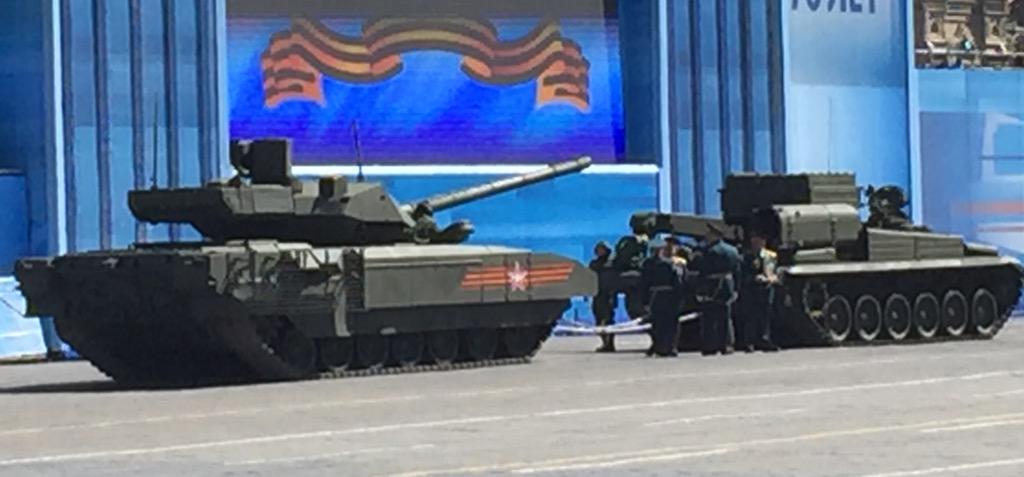
A banner affixed to one of the buildings in the city of Kaluga in anticipation of the V-Day celebrations reads: "Today, it's Crimea, Tomorrow, it's Rome" (Сегодня Крым, завтра - Рим). In Russian Crimea and Rome rhyme nicely, in "I like Ike" sort of way, lending the idea of Russia's invincibility a matter-of-fact air. The airwaves are filled with the same sentiment. The grandiose parade in the Red Square commemorating the seventieth anniversary of the V-Day is meant to supply the Kaluga jingoistic jingle with a visually compelling objective correlative, notwithstanding the new tank breaking down on the parade grounds the other day. But like all myths, the myth of Russia's invincibility, does not stand scrutiny. The actual record is mixed or worse.
      The so-called Mongol-Tatar Yoke hung over neck of Ancient Rus for over 200 years before the hordes were either vanquished or, as evidence suggests, decamped to deal with their own internal problems (1480). During the Time of Troubles 1598-1613), Polish forces, even though eventually chased away, occupied Moscow. After sweeping across Europe, Napoleon was defeated, too, but not before he occupied and burned down Moscow in 1812. Russia lost the Crimean War (1856), lost in the Far East to Japan in 1903-05, and, by all accounts, Russia was a loser in WWI, her defeat overshadowed by and prompting the Russian revolution. Soviet Russia, a.k.a. USSR, lost territory in its war with Poland in 1920, an outcome that stopped the spread of the Bolshevik revolution further West. The war with Finland in 1939 looks more like a pyrrhic victory, if not a defeat, given the Soviet's catastrophically disproportionate losses. The victory in WWII came at the mind-boggling cost in life (16% of the entire population of the victorious USSR, compared to Germany's, the defeated agressor, 12%), not to mention the incalculable treasure, and near-complete devastation of the Soviet territory west of Moscow.
     More recently, in the nuclear age, when wars between major powers became unthinkable, Russia competed with the West in the so-called cold war. The acceptance of the concept of the mutually-assured destruction, made a hot war -- "the last and decisive battle in the words of the International"-- impossible. Because of this, the contest was held in the sphere of "peaceful coexistence," that is, science and technology, third-world proxy wars, and, most important, production and consumption of consumer goods. USSR was sure to win this war, because History, pace Karl Marx and Soviet ideology, was on its side. Nikita Khrushchev took Soviet Marxist gospel at face value, and thought Soviet Union to be the proverbial "gravedigger of History." Sputnik worked its magic., too, and in 1956, eleven years after the V-Day, Khrushchev was bold enough to declare to the country's former allies: "We will bury you!" Soviet economists, anxious to please their boss, projected the post-war growth figures into the not so distant future, showing that the USSR was to "catch up with and overtake the United States" in a couple of decades. Victory was within the reach of a single generation. As we know, the Soviet Union lost that war, too, and not through some battle-field contest or because it lacked tanks or ICBMs, but by imploding from within the unsustainable structure it had itself built. 
      But the foreign engagements aside, there has been another war -- an endless one -- that Russia seems to have been fighting with itself. In the 16th century Ivan the Terrible pretty much exterminated the Russian high nobility, in the process eliminating a check on his autocratic powers and laying waste to the whole country. Following the reforms of Peter the Great, the Russian educated elite fought, mostly with the pen and the printing press, on occasion violently, against the autocratic state, until the autocracy imploded and was bloodlessly overthrown in February 1917. What happened next was a Bolshevik coup d'état, followed by the shattering civil war of 1918-21. A decade later, before the wounds had the time to heal, the Russians resumed their "civil war" during the Stalin collectivization of agriculture and later in the Great Terror, with devastating consequences for the nation. Whatever the exact math, the numbers of victims of Bolshevism and the Nazi Wehmacht appear to be comparable (see, e.g., The Black Book of Communism). But the effect of Stalinism on the nation's moral fibre, its talent pool, its dignity, its political culture, would last for generations. Despite the perestroika, the freedoms the Russians have been enjoying since the collapse of communism, these effects have persisted, witness public attempts to resurrect the cult of Stalin (a bust of Stalin was recently installed in the city of Lipetsk and quickly defaced).
     Fast-forward to August 1991, the Russians, it seemed, won against their Communist party-state, the machine that Stalin built. Yet, with the fits and starts under Yeltsin, Russia's cold civil war proceeded apace, at times spilling into violence, as it did in the anti-Yeltsin revolt in 1993 or the well-publicized government raids on misbehaving oligarchs, or a string of assassinations of political and media figures from Vlad Listyev to Anna Politkovskaja, to, most recently, Boris Nemtsov. Today, it is increasingly clear that the Leviathan of the Russian State (pace Hobbs and Andrey Zvyagintsev's brilliant film) - has gained the upper hand over the opposing voices in Russia's educated society. This "Leviathan" state, flaunting the quasi-divine sanction granted it by the Russian Orthodox Church, wrapped in the flag of the Victory in the Great Patriotic War, now refers to its internal opposition as the "Fifth column" (Vladimir Putin's March 18, 2014, "Crimea Speech"). Resorting to this archetype of war-time rhetoric, President Putin is holding an explicit threat over the heads of the dissenting professional classes, in effect, promising to unleash the "people's wrath" against them, should they continue questioning the legitimacy of what is by all accounts a monumentally corrupt and, even worse, incompetent state. Plenty of resources, unconventional by the old Soviet standards, seem to be available to Russia's long-time president, from the seasoned praetorian guard of the Chechen leader Ahmet Kadyrov that numbers in the thousands to the organized urban toughs, like the Night Wolves Bike club of which President Putin seems to be the honorary member.
      And so the internal cold war between the Russian state and its own Russian educated elite continues unabated, while the "silent majority," whose brain is wired to the state-controlled TV, continues to support the new tsar and grumble at the "national traitors" (национал-предатели - Putin's own, German-inflected coinage from the "Crimea" speech of March 18, 2014).
      How long this chapter in Russia's cold civil war will last and how it will end is an open question. In the meantime, dissenting voices continue to be heard, even as Putin's trick war with Ukraine has unleashed forces so dark that the Russian Leviathan, puffed up as it is, may be too fragile to handle.

Berkeley-Paris, January-May 2015


Monday, July 25, 2011

Russia’s Two Souls: On Andrei Zvyagintsev’s Film “Elena” (2011)


Awarded the Jury’s Special Prize at the Cannes Film Festival this year, Andrei Zvyagintsev’s “Elena” is a powerful cinematic feat, as distinct and subtle as his 2003 prize-winning “The Return,” but one whose story carries a greater resonance and depth. A small masterpiece, it will be appreciated by a thinking audience, one that prefers, on occasion, a bit of a work-out for the little grey cells, rather than have their eyeballs massaged by purveyors of eye candy. Like raw oysters, or Anton Chelhov’s “comedies,”  and unlike MacDonald's Big Mac, Zvyagintsev’s “Elena” calls for an acquired taste, and those who have it will come away feeling satisfied and rewarded.

On the surface, it is a typical human interest story about a conflict between a middle-aged couple, each on his and her second round, who disagree on ways to provide for their children. As in Chekhov, most of the elements of the story are eminently portable and could located in any modern society, and yet, as in Chekhov, they are all eminently Russian, and their particular coordinates of time and space are Russia today.


Zvyagintsev chose to make his film visually spare, muting its color palette to that of the arid late fall in the European North, and shooting most of the film with a  stationary camera, partial to the split focus effect. The overall ambience can best be described as a cross between a subtle Japanese water color and a glossy catalogue photo of a sterile Scandinavian furniture show room. There is a sound track to match. The opening scene in an upscale condo occurs in a sonic vacuum, punctuated by discrete quotidian noises of the morning rituals soon to be drowned in the chilling cheer of morning TV. Before long, this infernal auditory néant morphs into an itch-inducing, quiet-desperation score by Philip Glass. It is not so much against this minimalist buzz, as along with it, that Zvyagintsev unfolds before us his sophisticated moral – and sociological – picture puzzle.


What are the pieces? A good-looking, if a bit heavy-set, tall Russian woman Elena (Nadezhda Markina), in her fifties, a former medical nurse, now married to her ex-patient, a vigorous and apparently successful older businessman, Vladimir (Andrei Smirnov). Well-dressed, if conservatively and a bit on the matronly side, she emanates the aura of a fading Russian beauty: slow and glacial exterior belying, one imagines, the incendiary mix on the inside waiting for a spark. Her husband cuts a figure of a commanding stature: a self-made, no-nonsense top executive, with a taste for Danish furniture design, German motors, membership in a top-notch health club, a roving eye, and a medical cabinet well-stocked with Viagra.


Both have children from their previous lives. Elena has a no-good son Seryozha (Aleksei Rozin), who likes to spit from the high-rise balcony of his non-descript outer suburb housing project, a good-of-nothing high-school senior grandson, who looks up to the “hood’s” petty criminals, another one-year-old to follow in his bother’s footsteps, and yet another  on the way in the fertile belly of her daughter-in-law, a woman in her own image: pragmatic, indulgent,  down-to-earth and, as it turns out, with few moral scruples.

Vladimir’s daughter Katya (Elena Lyadova) is no good either, except that she is harmless. A thoroughly urban, upper-middle-class young woman, she arrives on the scene casually well-dressed and attractive, if a bit fatigued by her strict regimen of “food, sex, drugs, and alcohol only on weekends.” Like Seryozha, who lives off his mother’s pension and other hand-outs, Katya is not gainfully employed, but her indolence, we are led to understand, is the result of self-reflection and moral disgust with the emptiness of her world whereas Seryozha’s is habitual, non-reflective, even vegetative kind of idleness – the torpor of a creature with minimal social skills who cannot exist without his beer-bottle pacifier in his mouth.


Zvyagintsev could not have drawn a starker class line than the one between Vladimir and Elena: one the one side are the cosmopolitan, sophisticated father and daughter, on the other, the Russian meshchanstvo (petty bourgeoisie), a kind of lumpen
bourgeoisie, the blue- or white-color milieu, intensely materialistic and, despite the urban setting, still rooted in the traditional rural culture, with its unquestioned patriarchy, focus on fertility, and limited horizons. Indeed the “intrigue” of the plot revolves precisely around the difference in what economists and sociologists call time horizons of the husband and wife.

Vladimir’s world implies planning ahead and awareness of the cause-and-effect relationship between actions and consequences. Elena’s is the chaotic world in which needs and dangers – as in the case of the military draft for which every Russian eighteen-year-old is eligible – emerge unexpectedly and must be impulsively met and satisfied. Those who wish to avoid or delay the draft can do so by entering an institution of higher learning – either based on their transcript and exams, which requires a long time-horizon, discipline and  planning, or a miracle in the form of a lump sum, sufficiently rounded, to underwrite a bribe.  Where a peasant fearing drought would pray to a patron saint of rain, his latter-day urban descendant, a Seryozha or Elena, scheme for a one-time subsidy from the well-provisioned Vladimir.

Without giving away the story, the film ends with Elena’s family moving into Vladimir’s up-market spacious condo and planning to subdivide it in the same manner that the stately apartments of yore were converted into communal warrens of the Soviet era. The film’s parting shot through the window of the condo replicates the opening shot, amplifying the circular time of the film: “And the wind returneth to its circuits.” The “communal apartment” mentality, perhaps going back to the famous Russian peasant commune, mir, reasserts itself, whether under “socialism” or Russia’s twenty-first century oil-driven “capitalism.” What may otherwise bee seen as a human-interest story begins to resonate as an allegorical tale with particular sociological implications: the deep structure of the Russian tradition turns out to be more powerful than any new-fangled modernities, be they communism or capitalism.

As if to emphasize the allegorical turn of the film narrative, Zvyagintsev sets the film in “Any Metropilis” (anyplace vs. the utopian noplace) of today’s Russia, one with a leafy neighborhood for million-dollar condominiums and the infinite urban sprawl of the housing projects for the less fortunate Russians whose outer reaches require travel by rail. All topographical details that might determine the particular setting have been excised. Zvyagintsev is laying a claim to a myth which can serve as a template for any region of his country. With its pieces fit into place the picture puzzle becomes an allegory, one with a considerable historical depth.


In Russia, to unpack Zvyagintsev’s allegory, the great reforms, whether of Peter the Great, Catherine, Alexander I, Lenin, Stalin, Gorbachev or Yeltsin, sooner or later run out of steam, and the traditional, semi-rural culture of Russia absorbs and swallow up, like a predatory plant or a swamp, whatever “foreign” agency has once disturbed its surface. Elena stands for the traditional, semi-rural, semi-urban  Russia – her taste for kerchiefs and scheming (khitrost) are the tell-tale signs of her peasant wiles. This is the fate that awaits the film’s protagonist Vladimir and his restless off-spring Katya. The victory is Elena’s and her son’s.

With the puzzle complete, the film’s pedigree in Russian literature and its discourse on Russian culture and history becomes more obvious. The film echoes Denis Fonvizin’s classic comedy The Minor (1798), in which the mother’s protective love for her son and her inability to enforce discipline destroys his career prospects, to Goncharov’s novel Oblomov (1859) in which the Westernized Russian protagonist ultimately regresses into the embrace of an indulgent “Elena,” to Isaac Babel’s “Tale About a Peasant Wench” (1917) in which the ever-fertile peasant whore Arina smothers the angel Alfredik who had been sent by the Almighty to redeem her sins.

A hundred years ago, as Russia entered WWI, Maxim Gorky elaborated this view of Russian history in his controversial essay “Two Souls” (1915). "We, Russians, have two souls," he wrote, "one descends from the Mongol nomad, a dreamer, a mystic, indolent and convinced that it is impossible to challenge fate; and right next to this impotent soul, lives the soul of a Slav; it may ignite a beautiful bright flame but it burns itself out quickly, and it is helpless against the poisons sapping its strength." However dated Gorky's "Two Souls" may be, the film maker Zvyagintsev challenges our understanding of today’s Russia by reviving Gorky’s harsh take on some of Russia's ingrained cultural patterns. 

Choosing to call his film “Elena,” not “Vladimir,” Zvyagintsev accents his vision of the county, telling us which one of  the “two souls” is on the ascendant in Russia today. 


Copyright © by gfreidin@stanford.edu 2011