Sunday, May 19, 2013

Alexei Balabanov. 1958-2013. In Memoriam.

One of the most talented, masterful and remarkable Russian cinematographers, Alexei Oktyabrinovich Balabanov, died suddenly on May 18, 2013, at the age of fifty five, in his family residence outside St. Petersburg.
        Aleksei Balabanov and Agniya Kuznetsova in 2007 after the showing of "Cargo 200"at the Sochi Film Festival in 2007

Russian cinema of the last quarter century, indeed contemporary Russian culture, is unthinkable without his "Brother" (Брат)  a gangster thriller about the early years of post-communist Russia that became folklore as soon as it was released in 1997; or his film "War" (Война) with its chilling stereoscopic (Western and Russian) view of the Chechen conflict (2002); or his blood-curdling, Gothic vision of Putin's Russia, "Cargo 200" (Груз 200). His sixteenth, and last, film, the mystical "I Want It, Too" (Я тоже хочу), came out in 2012.

For years now, I have been collecting notes for a long essay on Balabanov's cinematography and its deep roots in Russian intelligentsia mythology, including Russian nationalism, and contemporary popular culture, Russian and Western. A rock musician in his youth, he has been an unrivaled master of the sound track. The soundtrack for "Brother" I and II is the best anthology of contemporary Russian rock, which should be a thrilling discovery for those not aware of this period music. Ditto his "War." It opens with a Jihadist rock song in Chechen-accented Russian, cycles through the best of Splin, Bi-2 and others, and culminates with Butusov's piercing "My Star" (Моя звезда). The website for Balabanov's soundtracks is here.

Osip Mandelstam once called Baudelaire a martyr of modernism "in the true Christina sense of the word." It is in this sense, too, that Alexei Balabanov was a cinematic martyr of Russia's contemporary cinematography, so much did he identify with Russia's pain and her fragile beauty. I may yet write my long piece on Balabanov's cinema, but in the meantime. as a tribute to him, I am reposting my short essay on "Cargo 200." The piece appeared in "Film Watch," the magazine of the Telluride Film Festival where "Cargo 200" had its American premiere in August 2007. Click here to ro read the publication or simply read the text below.  

19 May 2013. Paris


Russia's Grey Underbelly
Aleksei Balabanov's Thriller Reveals Soviet Corruption
 (Film Watch (Telluride Film Festival. August 2007): 72-74

By Gregory Freidin

On the surface, Aleksei Balabanov's Cargo 200 is a noir thriller about a psychopathic police captain in a provincial Russian city, one of those industrial hellholes that pockmarked the face of the U.S.S.R. The month is August, the year the Orwellian 1984. It was then that the angel of history despaired of the Soviet Union and made way for Mikhail Gorbachev. Historically authentic, Balabanov’s packs his Cargo 200  with such a strong allegorical charge that the result is a double exposure of Russia then and now, perhaps, forever. The film has polarized the opinion and set the whole of Russia talking—a sign of the rebirth of Russian film and engagé art.


In 1984, Balabanov was 25, college behind him, and serving as a paratrooper in Afghanistan five years after the Soviet invasion. The USSR itself was 67 and stagnating. Keep this in mind as Cargo takes you to the Captain Zhurov’s fly-infested apartment; think also about the corpse of Vladimir Lenin, embalmed and still open for display outside the Kremlin, a ghoulish symbol of the country’s historical freight.

Balabanov heaves it out of storage. We are treated to close-ups of recycled pickle jars and vodka bottles, armored apartment doors, dilapidated buildings, classic Russian and Soviet kitsch, by now vintage Soviet jalopies, and Soviet TV footage that will set your teeth on edge. All objects are lit with bare bulbs, flashlights, hurricane lamps, primitive disco strobes and, for the most part, the kind of diffuse gray northern daylight that one imagines illuminates the better parts of hell. As always, Balabanov provides a lovingly selected period soundtrack with lyrics that create another layer of meaning. The illusion of authenticity he achieves is powerful, and those who lived under the old U.S.S.R. may break into a cold sweat realizing how little has changed. Cargo was shot on location, not far from St. Petersburg (Leninsk is the actual steel town Cherepovets). Apparently, all Balabanov’s crew needed for time travel was a set of wheels and a tank of gas. Pity Sasha Baron Cohen, who had to travel to Romania to get to his "Kazakhstan.”

Not having to go far, Balabanov digs deep, raising questions both about recent history as well as Russia’s much older romance with alcohol, corruption, xenophobia, and a rigid authoritarian state known for using extreme violence against its own people. Lest we forget, Balabanov has captain Zhurov head the Dzerzhinsky district of the Leninsk police department, the point amplified by a huge bust of Felix Dzerzhinsky, the founder of Cheka (now FSB),  next to Zhurov’s desk.

As in fairy tales, the film's three female figures stand for the three faces of Russia. The 18-year-old Angelika embodies Russia’s present, a spawn of the stagnant Soviet Union. Zhurov’s old mother is a caricature of Soviet citizenry, their minds shot by alcohol and propaganda. She is permanently glued to her TV and a glass jar full of hooch. And Antonina, wife of the underground distiller Aleksei, is a traditional good Russian woman, who is helpless to change anything (she fails to prevent the rape of Angelika) but is loyal and effective in her revenge.


For the main male characters, Balabanov uses his favorite “brothers” device, arranging them in three sets. The “fathers” are the 50something colonel from Leninsk and his Leningrad sibling Artem, a professor of Scientific Atheism. Both worry about the future and are corrupt. Their “sons” are more despicable. Slava—that's Russian for "glory"—is a good-for-nothing hedonist. The shady operator Valery ("healthy" and" strong”) wears a red T-shirt with huge letters USSR on it and is romancing the colonel’s daughter to avoid the draft. As in the old Soviet joke about Pravda and Izvestia, which contrary to their titles contained neither truth nor news, the “sons” have no claim to either glory or strength, or health. Valery turns out to be a hopeless drunk and coward: he abandons Angelika to her abductor and flees from the area reluctant to get entangled with the police. As the film ends, he and Slava strike up a friendship of convenience, and we see them in a fading shot poised to spin out deals and become tycoons in today’s Russia. The film’s only other young man of their generation is Angelika’s long-awaited boyfriend, heroic Sergeant Major Gorbunov. He arrives in a sealed coffin, the film’s actual cargo 200.

At the core of the tale are Aleksei (the director’s namesake) and captain Zhurov ("glum") who belong to neither generation and are, in a way, outside of time. They formed a bond, based on some secret, while Aleksei serving a ten-year term for manslaughter. The bond remains so strong that when asked by Zhurov, Aleksei accepts a death sentence for the murder committed by Zhurov. What their secret was is never revealed, but the film as a whole implies that, whoever different , Alexey and Zurov are invisibly joined at the hip like Siamese twins.

They are eternal Russian types, locked in the eternal Russian sadomasochistic drama. Alexei may indulge in a drunken Dostoevskian “conversation across eternity” with the professor of Scientific Atheism, wax eloquent about God and spin visions of utopian socialism. But he thinks nothing of forcing himself on Angelika the moment she walks in and would have, had he not conked out in a drunken stupor. Antonina hides Angelika in the peasant bathhouse where Aleksei keeps his illegal still but Zhurov picks up where the other left off. He finds Angelika there, forces her onto all fours and sodomizes her … with an empty vodka bottle. Soviet times, Balabanov is implicitly quoting from Dostoevsky, are the “eternity that is nothing but a peasant bath house with cockroaches in every corner.”

The rape scene is hard to take. But if you don’t look away, you notice a shadow of pleasure flit across Angelica's face—a form of consent between the victim and the victimizer. Balabanov links Angelica’s violation to Russia’s romance with alcohol. If Angelika-Russia is the enabler, then the police officer, who instead of protecting, gruesomely violates an innocent, rises as an embodiment of the brutal Russian and Soviet state for which vodka—before they struck oil—was the biggest source of revenue and civil quiescence.

In the morning, Zhurov handcuffs Angelica to his motorcycle. Their ride through the industrial outskirts of Leninsk is perhaps the most haunting long shot of the entire film, an inversion of the motorcycle glamour. Zhurov is taking his victim into the heart of—no, not darkness, but worse—Soviet industrial gray. Shooting in color, cinematographer Aleksandr Simonov proves himself the supreme connoisseur of every possible non-descript tint. Elevated tracks, intertwining pipes, smokestacks, girders, cables and cooling towers fly by, forming a cruel backdrop to Zhurov’s handsome stiff-backed motorcycle posture and Angelica’s face with smeared eyeliner and flowing mane.

Balabanov inverts the opening of Easy Rider and has a soundtrack to match Steppenwolf’s “Born to Be Wild.” As Zhurov rides, his prey handcuffed to the sidecar, the voice of Yuri Loza croons: " Through storms and rain, taking with me only my reveries, my childhood dreams, I shall float away on my little raft, … let my journey be hard … and perhaps I shall come to know the world in which I live … perhaps shall find a new bright and colorful world …”

Gregory Freidin, Professor of Slavic Languages and Literatures and Director of Interdisciplinary Studies in Humanities at Stanford University, is author of a critical biography of Osip Mandelstam, A Coat of Many Colors (UC Press, 1987) and forthcoming critical biography of a Russian Jewish writer Isaac Babel, A Jew On Horseback (Stanford University Press). He has been a commentator on Russian affairs for the Voice of America, BBC, PBS, and CBS.

Copyright © 2007 by Gregory Freidin 


Friday, December 28, 2012

Women Dancing in the Streets of Moscow in 1947 (Through the Lens of Robert Capa and Henri Cartier-Bresson)


By happenstance (a post on Facebook), I came across an incomparable series of photographs by Robert Capa of Moscow 1947 (the post led me to the site with a big set of pictures of superb reproduction quality). One of them - women dancing in the street - was riveting and would not let me go. I followed the trail...


Robert Capa visited in the Soviet Union with John Steinbeck on an assignment for The New York Herald Tribune. They were supposed to produce a series of human-interest reports about the people living through the post-war reconstruction of the USSR. The real cold-war freeze was just setting in, and an average American was puzzled by the changing tone in the political relationship between Soviet Russia and the West. Only recently, USSR had been a staunch ally of the West in the war against Hitler. Now it was morphing into the Big Other. “A shadow has fallen upon the scenes so lately light by the Allied victory,” as  Churchill put it in a language worthy of an epic poet, and “from Stettin in the Baltic to Trieste in the Adriatic an iron curtain has descended across the Continent. Behind that line lie all the capitals of the ancient states of Central and Eastern Europe. Warsaw, Berlin, Prague, Vienna, Budapest, Belgrade, Bucharest and Sofia, all these famous cities and the populations around them..." (The Fulton Speech, 5 March 1946). 

Could this grim epic be true and was the world on the brink of the third great war of the century? The author of The Grapes of Wrath and, perhaps, the world's most  famous war photographer were supposed to sort it all out by observing and reporting on the daily life of ordinary Soviets. Steinbeck's reports and Capa's photographs were serialized beginning January 1948 and later in the year appeared under Steinbeck's name as A Russian Journal, with Photographs by Robert Capa. The book is still in print.


Their forty-day-long trip happened to coincide with a festive celebration of Moscow’s 800th anniversary, held on September 7, 1947. I was then a little over one year old but the echoes of the event reverberated throughout my childhood (we lived in the center of Moscow halfway between the Red Square and Chistye Prudy). I remember playing with the colorful commemorative insignia (few things were colorful then) and hearing my parents, probably in answer to my questions, refer to the celebrations with uncharacteristic ebullience. Clearly it was a major landmark of the post-war years in Stalin's Russia.


Having won the other Great War, USSR was now a superpower and -- recall Churchill's Homeric catalogue of cities on which the USSR has cast its "shadow" -- a great world empire. Empires need historical legitimacy, and the mere three decades since the Proletarian Revolution of 1917 came woefully short, especially now that the revolutionary proletarian class had been enhanced, if not entirely supplanted, by the "great Russian people, the leading people among all of the peoples of our country," as Stalin famously put it in his Toast at the Victory Dinner in the Kremlin on 24 May 1945. Once and for all, the proletarian internationalism had to yield its pride of place to Russian nationalism. The 800th anniversary of Moscow’s first mention in the Primary Chronicle came in handy. This anniversary had been celebrated once before, in 1847, on the prompting of the Russian Slavophiles. Then, as now, it provided the empire with an almost millennial stretch of usable history.

This round, doubly symbolic, date became a cornerstone of the new era, and it was marked accordingly by laying the foundation of the eight Moscow skyscrapers, the buildings that were to define the city’s skyline into the future imperial century. And they, in fact, do even to this day (ultimately, only seven were built). And then there were the festivities to match the momentous occasion. The city was outfitted with illumination fit for a Roman carnival or Paris on the Bastille Day. The center of Moscow was filled with the sound of music, both live and blasting from the public loudspeakers. Temporary stages were set up on which couples of professional well-dressed dancers twirled to live music to encourage the people below stage, the survivors, exhausted by the years of war and privation, to do the same. There is a one-minute clip showing such a street scene in Moscow. 


Now, Robert Capa, one of the century’s most celebrated  photographers, the hero witness to the Spanish civil war and the Allied landing in Normandy three years earlier was to document the Soviets’ transition to peace.

Judging by most pictures, Capa was shooting with a 35 mm lens (slightly wide-angle) - a reporter's tool to capture the context while getting in close to the subject, the tool also favored by his friend Henri Cartier-Bresson. (On this trip, Capa had with him a Contax and, photo to the right, a square format Rolleiflex and, according to A Russian Journal, two more cameras and lenses).

Getting close to the subject, though, turned out to be difficult. He could not move around freely and shoot even though he had his permits and his official guides from VOKS -- not until, that is, he partnered with a Soviet "photographer," no doubt of the Lubyanka provenance, who could ward off policemen. (Viktor Tolts of Radio Free Europe located and interviewed their VOKS interpreter.). This not to mention that his Soviet subjects, especially in Moscow, were, as Steinbeck noted, camera shy before an American reporter. This is why we often see his subjects' backs -- with the eyes the Great Leader staring at them from giant posters or, as in the picture on the left, from a giant piece of porcelain. This composition -- the photographer watching the subject being watched by another -- had a venerable pedigree among the artists touched by surrealism.

Some pictures were taken from hotel windows, like the one the right of the Theater Square and the Bolshoi, when Capa was shooting from the Metropol in the late afternoon sun (the long shadows). Some of the night shots of the Kremlin were taken from the balcony of the suite occupied by Louis Aragon and Elsa Triolet at the hotel National.


And yet, whatever the restrictions, this war photographer was able to convey the atmosphere of the 1947 Moscow. Indeed, many images are composed to give expression to the wrenching tension between the ordinary folks' desire to cash in a little of that great WWII victory -- to ease gently into the long-deferred private life -- and the unspoken command shouting at them from every poster: "Attention! To the Glory of the Empire, March!" 

A cluster of women in the image below are sitting this way and that on the bench in a small park in front of the Bolshoi Theater. They are enjoying a bit of sunshine and a quiet moment with a book, while behind them Apollo, with the USSR coat of arms above his head, is barely capable of restraining his charging horses. His ancient chariot is now festooned with an array of erect pointed flagpoles, flags taut, one for every constituent republic of the Soviet Union. Below them and right above the women's heads hang the giant faces of the ageless leaders -- one dead, one very much alive. Between the two heads, as if knitting them together, are the words of the new Soviet anthem: "The unbreakable union of free republics has for ages been bonded by Great Russia..." The neoclassical architecture of the Bolshoi Theater, with its slightly Baroque Ionian columns and classical double pediment crowned by the Soviet Union's coat of arms could not be better suited to serve as an emblem of a centuries-old, newly-minted empire. What contrast all of this imperial paraphernalia provides to the female figures -- young and not so young, bare-headed, kerchiefed, and one with a fashionable pointed hat (echoes of better times?) -- relaxing on a park bench on a brilliant sunny day in an unseasonably cold Moscow! The contrast is even more striking for the complete absence of men or children around them. Will these women have to be forever married to Lenin and Stalin, captives to the the frigid union between the mothers of their land and the fathers of the empire? 


Coming of age as a photographer in the decades of Surrealism, Capa, like his friend Cariter-Bresson, sought out in his reportage a "found object," or as Cartier-Bresson redefined it, the "decisive moment." What, then, was Capa’s decisive moment in his Moscow pictures? His shutter clicks in that ineffable split second that separates the longed-for deep breath of his subject and a furtive, incomplete exhale, constricted by Stalin's sphinx-like gaze. The photograph showing a model at the fashion commission meeting is another exemplary image. The picture is awkward, absurd, comical, and heart-stoppingly chilling. Generalissimo Stalin's gaze dominates, refracted and dispersed into the smaller gazes of the judges on the committee.


But there are exception, and the most notable one, when the camera looks straight into the faces of his subjects and meets their eyes, is Capa’s photograph that caught my attention in the first place: two women dancing with each other in the street on that festive September Sunday (Saturday was a workday). The location is easy to figure out. They are dancing at the corner of Okhotny Ryad and Tvesrkaya, right in front of the Hotel Moskva, with the Hotel National, the Intourist building, behind them.


September 7 was one of those liminal days when the air is cool and the pale blue sky is open and sunny (there is just a wisp of a cloud in the top left corner). The woman facing the camera is wearing a thick shawl and a heavy coat, the other is in a light dress, epitomizing the two sides of the Russian “Indian summer” and, perhaps also, the desire to use hope to trump the cold reality, for "it was a brilliant cold day," as Steinbeck noted in his Journal. Both women are young and beautiful and strikingly dignified. But their faces suggest a more complicated story. The furrowed brow, the lines around the mouth, the alarm in the eyes of the woman facing the camera -- what is behind them? And what about her dancing partner? Alone in the frame in a white flowery dress, her hair beautifully arranged, but her gaze is fixed on a point in infinity and her  profile is frozen into a classical tragic mask. Her right arm, bare and vulnerable, is gracefully stretched out, and the slight curve of her back is protected by the hand of her partner, apparently, stronger and more practically dressed. The tension is palpable. Were the music to stop at that moment, one of them and perhaps both would hunch over and burst out crying. To make sure your are not imagining all of this emotional dynamite, you check their expressions and posture against the other two female couples in the background: they, too, look tentative, dispirited, and forlorn, though lacking in grace and dignity compared to the couple in the foreground. The out-of-focus smiling faces to the right of the dancers only amplify the grotesque contrast between the intended mood of the festivities and the pain of the city's post-war life. So much sadness fills this instant captured by Capa that it can never be effaced or redeemed. 

Seven years later, in 1954, a year after Stalin’s death, and, it happens, a few months after Jean-Paul Sartre and Simone de Beauvoir attended the May Day parade in Moscow, Henri Cartier-Bresson, Capa’s good friend and, with him, a co-founder of the Magnum Agency, made a trip to the USSR. He was the first Western photojournalist to be allowed the privilege of touring the Soviet Union since Stalin's death and, perhaps, even since his friend's 1947 visit. He produced a fuller, richer set of images, with plenty of faces not shying away from his Leica lens. Cartier-Bresson was a greater artist than Capa and enjoyed better conditions in the USSR, then slowly beginning to “thaw” from the deep freeze of Stalinism. O what a difference do seven years make! Or perhaps, not just the seven years. Cartier-Bresson was also more "engaged," to use Sartre's term, and had, for awhile, belonged to the French Communist Party (see Jean-Pierre Montier, Henri Cartier-Bresson, figure de l’« intellectuel » ?). One needs only to compare his sets of photographs from the USA tour of the 1930s and 1940s with the pictures from his 1954 tour serialized in Life in January 1955 and later that year collected into The People of Moscow. US is sinister, violently racist, aggressive and plutocratic. USSR is, well, a bit backward, a bit absurd, but always charmant.

Going to Russia, Cartier-Bresson was, no doubt, aware of Capa's Russian Journal and considered it a challenge. More than a challenge. Robert Capa, who had sworn after Normandy never to go to a combat zone, died on May 25 of that year after stepping on a land mine while covering the Indochina War. Carier-Bresson arrived in Moscow in August. I suspect that on one of his first days in Moscow, he recognized the scene matching the striking imаge of the dancing women captured by his now late friend and forever an artistic rival. The women's posture is almost a replica of Capa's image but instead of the post-war tragic sterility of a female couple dancing, frozen in a catatonic seizure of the shot, Cartier-Bresson's young women are eagerly eyed by two rakes in uniform, even as the street car in the background (echoes of Dziga Vertov?) adds to the dynamism of an urban scene. 
Recognition was instant, instinctive. Echoing Capa's decisive moment, Cartier-Bresson squeezed the shutter, et voila -- the match was complete. 


For me, the two photos, their horizontal and vertical composition complementary, stand as deeply moving emblems, Capa's of the post-war state of shock in Stalinist Moscow, busy refashioning itself into a world empire, Cartier-Bresson's, for the year of hopes of Moscow's Thaw generation. And even if I realize now that Capa, the archetypal battlefield photographer, continued to see the tragedy of war in the peacetime Moscow, and Cartier-Bresson framed his Russia to accommodate the notions of a French leftist intellectual regarding the world's first Socialist society, both images continue to haunt me — and shape the memory of my own and my country’s past. The magic aura of these images is undiminished, perhaps, even amplified by their digital multiplication. 

I shake my head in disbelief... Could it be, then, that the rumor, publicized by Walter Benjamin, of its demise in the age of mechanical, now digital, reproduction of art was a little exaggerated?

Berkeley, 27 December 2012


Sunday, December 16, 2012

Apropos Sandy Hook


Jean Louis Hamon's 1852 painting "La Comédie Humaine" hangs at the Musee d'Orsay in Paris. I spent a long time standing before it - so well it captures for me the drama of the "public opinion" and the roles of writers and artists in shaping it, exactly at the time that the phenomenon was emerging as a major social and political force. Illuminating of the historical moment, for me, it was also mystifying and disturbing because of the scene of violence on the puppet theater stage at the very center of the composition. I was at a loss to explain it - until the gruesome events at Sandy Hook have somehow re-articulated this image.  

The "folk" in the audience (the parents and their children) are mesmerized by the spectacle, at once naive and horrifically violent, and are dumbstruck like the "silent people" (народ безмолвствует) at the end of Pushkin's "Boris Godunov." But not so, the symbolic figures on both the right and left of the puppet theater. These are the grand interpreters of the course of human events, the Homers, the Virgils, and the Dantes: one easily recognize the skeptic Diogenes, the great dramatists Aeschylus and Aristophanes, and a line of heroic Romans, along with Alexander the Great (?). These wise men are ready to speak, to aver, to pronounce that this is the way the world is. We know from school to trust them as the wise men who turn the chaotic spectacle of human events into a decipherable allegory, the men who disclose history's true meaning, or simply make it so. But do they? Hamon, who placed the wise Athena on top of his Theatre Guignol, gives us a pause.

His "La Comédie Humaine" (he borrowed the title from Balzac series of novels) looks at us from the mid-nineenth-century France, where the tragedies of the ancients appear to have been replaced by the puppet theater allegory of the modern times, when all feel manipulated like marionettes by  indiscriminately cruel, unpredictable and invisible forces. Keep staring at the painting, and you will notice that the sages, too, appear a bit deflated, helmets, laurels, and togas notwithstanding. They no longer make their appearance one at a time, as they once did dominating their particular historical horizon; in France of 1852, and everywhere since, they show up as a crowd, like hawkers, each proffering his own understanding, his own book, each competing for our attention in the global flea market of symbols and ideas. Is the truth of Homer better than the truth of Dante? Or does the truth of Dante invalidate the truth of Homer, as it did once? Was Diogenes right to doubt it all? 

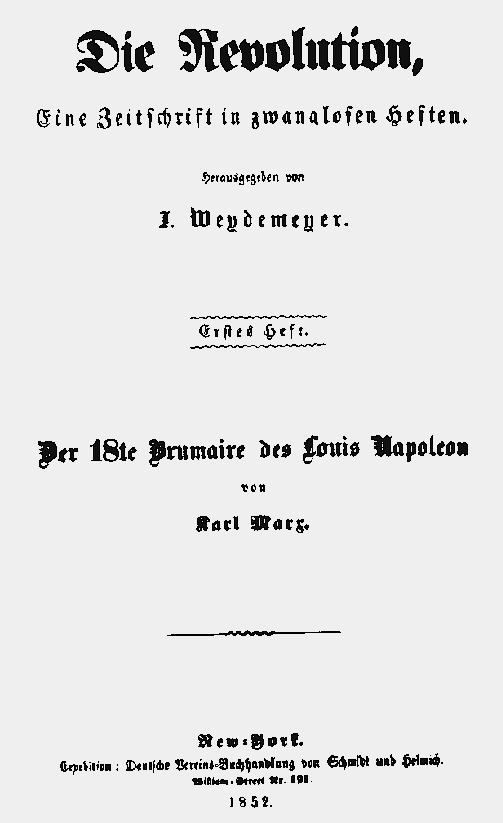
Nobody can answer these questions with certainty. Hamon, who had chosen for his subject the outdated Neo-Grec style, treats the canonical authority of his heroes with barely disguised irony -- the master trope of modernity, one impossible to shake off in the aftermath of a failed revolution of 1848, the so-called Spring of Nations. When Hamon exhibited his painting, Louis Bonaparte had just staged his cup d'état (December 1851), echoing the coup d'état of Napoleon Bonaparte, his brilliant uncle. Analogous events appear in history, Marx quipped famously, "first time  as tragedy, second time as farce"(The Eighteenth Brumaire of Louis Napoleon, 1852). Hamon's irony had an even sharper edge: his great tragedians, poets, philosophers, and statesmen practically elbow one anther, each flogging his own take on the riddle of history, seemingly oblivious to the fact that it is simply not possible for all of them to be right. 

Half a century later, the Russian poet Alexander Blok was smitten by the same ironic allegory of "Theatre Guignol". For him, as for many of his contemporaries, it resonated deeply with their own profound disenchantment following the failure of the Russian revolution of 1905 (and for Blok, personally, his frustration with his own mystical premonition of redemption). Like Jean Louis Hamon in "La Comédie Humane" and Marx in The Eighteenth Brumaire of Louis Napoleon, Blok gave us a Theatre Guignol version of his own time: the play "Puppet Theater" and a related short dramatic vignette by the same name, with its heart-breaking ending: "The boy and the girl are weeping -- the jolly puppet show is over" (Плачут девочка и мальчик - закрылся веселый балаганчик). Blok's use of the puppet theater motif  and, perhaps, Hamon's, too, later inspired Igor Stravinsky and Vaslav Nizhinsky to create the ballet "Petrouchka" which, coming full circle, premiered in Paris in 1911. Few theatrical works offer a more powerful -- and more colorful -- drama of disenchantment than this tale of a puppet's unrequited love, the loss of innocence, and more profound still, the loss of illusion.

Hamon's painting, then, should offer a powerful allegory on which to meditate. As we ponder, struck with grief, the senseless slaughter of Sandy Hook, we may also wonder at our  compulsion to look for answers and our inability to find them. When confronted with a horror that violates the fundamental assumptions about the way the world works, we can either seek solace in religion, apparently, not an option for Jean Louis Hamon, or can take time to look at and meditating on his painting. For it encapsulates the utter helplessness of reason and imagination, no matter how majestic and deep, in dealing with what is unthinkable – and real. 


Perhaps, this the insight that Jean Louis Hamon wished us to take away by having the horrific Theatre Guignol serve as a pedestal for the goddess of wisdom, Athena.

12/16/2012

Wednesday, December 14, 2011

In the Shadows of Ancestors, Invented and Forgotten. Two Recent Films from Russia

Ever wondered what happened to Oedipus? Look for the answer in two very different recent films from Russia, Silent Souls (Овсянки, dir. Alexei Fedorchenko) and I Will Remember (Буду помнить, dir. Vitalii Votobyev, 2010). Silent Souls will be screened publicly by the SF Film Society at the end of December 2011.

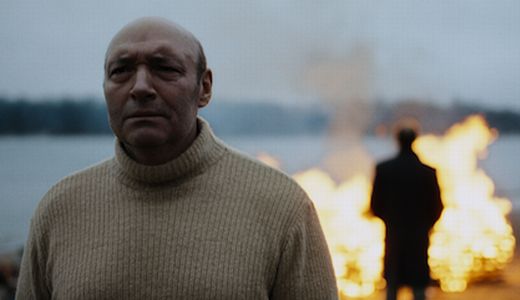
Silent Souls (Ovsyanki) could have been shot by Fellini if he had been exiled to northern Russia and denied access to Kodak color film but could lay his hands on some desaturated version of Agfa. It felt l was watching some Northern version of Amarcord or La strada. No wonder it received the best cinematography prize (camera work by Mikhail Krichman) at the Venice Film Festival and was among the top three favorites to receive the Lion d'Or that year. Director Aleksei Fedorchenko sets out to tell a story about a tribal identity, almost forgotten and practically invisible (possibly, totally invented),  yet concealing an ethnic difference as unsettling and relentlessly insistent – as a maddening itch between the toes of one’s amputated foot. 


Visually, Ovsaynki, with its mildly infernal leaden color scheme and wan faces of its protagonists, can be classified as   mournful elegy for a lost love,  composed in Hades. No sun shines there and, given the story, it is just as well. Most of the plot is deals with a bereaved husband and his friend driving an SUV, the body of the dead wife in the trunk. Their destination is a woodsy riverbank where the pair spent their honeymoon decades earlier and where now the husband plans to hold his wife's funeral — in accordance with some ancient custom, rooted in the archetypal recesses of his Finno-Ugric tribal memory.


But as you get deeper into the story, you begin to realize that “Silent Souls” is really a puzzle  about identity in the age of globalization. The main characters are two utterly average and average-looking middle-aged Russian guys. There is nothing special about them, except that they also happen to be descendants of an ancient Finnish tribe, by now almost completely forgotten, absorbed by ethnic Russians and their modern urban culture or, if you will, largely “globalized” out of existence. And yet, that ancient pre-modern world has left some of its tiny traces, still sufficient for reminding its descendents of their difference. Osip Mandelstam, writing about his largely secular childhood, observed that the family's Judaism, utterly vestigial, still reigned its odor: like musk oil, a tiny drop of it was sufficient to fill the whole house with its scent. Even less than a drop has survived of those ancient Finnish customs, and yet, we see that even a homeopathic quantity — a mere aura of the forgotten world — is capable of filling the space between the low-hanging, impenetrable cloud cover of the European north and its barren earth blanketed by sickly local flora where it has not yet been replaced by the anonymous twenty-first-century urban sprawl.


This is what makes “Silent Souls,” despite its ethnographic specificity, an allegory for the human condition of our age. The few ancestral traces that are left — names of rivers and odd fertility rites — are enough to create the urge to recover the rest but those who yield to it and  search search to recover some mythic plenitude wind up before a black hole and as happens to the two main characters, get sucked into nothingness. The sparrow-like birds (the Russian ovsyanki of the film’s original title) that “remind me of something that I seem to have forgotten” (the narrator’s words early in the film) turn out to be the harbingers, not of fertility (Aphrodite's sparrows), but death. There is, then, a calculated mythic inevitability about the plot: what the main character has “forgotten” and is trying to recall with the aid of the ritual turns out to be — the death wish itself.


The story unfolds against the alternative world of an endless stream of cars on a superhighway and a “global” Japanese fast food in a shopping mall with its big box  retail outlets. As the two protagonists trek through some deadly large appliances section of a Russian Costco, you begin to feel a chill spread down your spine. No amount of casual sex with the odd-looking girls, who seem to have been sent from the northern branch of Federico Fellini’s central casting, can compensate for the emptiness of the discount shop plenitude.


Fedorchenko seems to be offering us a moral: you can, if you wish, recover your lost identity – but only as you drive off the bridge into the Volga and join the world of the fish. This quiet despair about the human condition in the globalized world is what moved me deeply about this film. Fedorchenko shows people like us — twenty-first century, middle–class, educated — caught between the Scylla and Charybdes — between dissolving our identity in the globalized traffic flows of everything and trying to recover the imagined long-lost fullness of some communal, tribal life. If the movie is to be taken at face value, Odysseus was the last one to be able to steer clear of the two.

* * *

I Will Remember (Буду помнить), although not in the same league, is also about the "lost identity" nostalgia but of a completely different kind: a WWII melodrama that is good for your soul. The setting is Mineral Springs (Mineralnye body), a provincial town, a vacation spot, in the North Caucasus at the beginning of the war. The main protagonist is a an angry teenager, a Russian of Greek descent, who gets drawn against his will into helping a Russian boy of Jewish descent, a visitor form Leningrad, escape the holocaust after the Nazi invade his native town. If the color scheme in Silent Souls tends toward the mind-numbing leaden gray, I Will Remember dazzles with its gold, so warm and gentle that it could easily have been shot in Southern California. The golden glow has something to do with the nostalgic simplicity with which Russian tend to view the uncomplicated, if brutal, life in Stalin’s time. The erstwhile egalitarianism of poverty and the petty vanities of the petty ruling elite look refreshing — the Great Terror notwithstanding — to people used to the evermore rigid stratification and astronomical income inequalities of post-Soviet Russia. In the film, as the Soviet Army retreats from the town of Mineral Springs, Soviet order disintegrates and with it, the fabric of Soviet identities, revealing a society of far greater diversity in terms of class, ethnicity, religion, ethics, attitude towards the regime, and national commitment.

Remarkable for a film that appeals ostensibly to a wide audience (it may have been meant as a television movie), it reshuffles the deck of moral certitudes in such a way that even the evil characters gets to do good (a collaborator saved the protagonist who is about to be executed as a Jew) while the good ones, especially the boy’s father, can display bad judgment when faced with the choice between public weal, pleasing his boss, and the fate of his loved ones who depend on him for their survival.


One motif of the film is a handshake between the good and bad characters. Again and again, after a momentary hesitation, the hands are joined, as if in an allegory of an imperfect and ambiguous moral universe. The film clearly belongs to the age in which the necessity for moral compromise, at least a tactical one, is widely acknowledged. Such ethical sophistication is a far cry from the Russia of Tolstoy and Dostoevsky, let alone the Manichean ethics of the Soviet era. Not to belabor this point too much, though, in the film itself, justice triumphs, if imperfectly,  and the  family with the right moral instinct gets to have a future.


The two boys meet again in the epilogue, this time, as men in their seventies. If in Ovsyanki, the ordinary looking Russian men and women turn out to be, because of their ancestry,  anything but ordinary, in I will Remember, the difference between Jews and Christians, originally so stark, is completely erased. The film opens with a fight between the two boys, each infuriated with an insult to his ethnicity, but in  the epilogue, the Greek and the Jew, both in their hale seventies, meet again — one a well-known Russian author, the other an Israeli General — as if they were fraternal twins accidentally separated at a younger age.

* * *

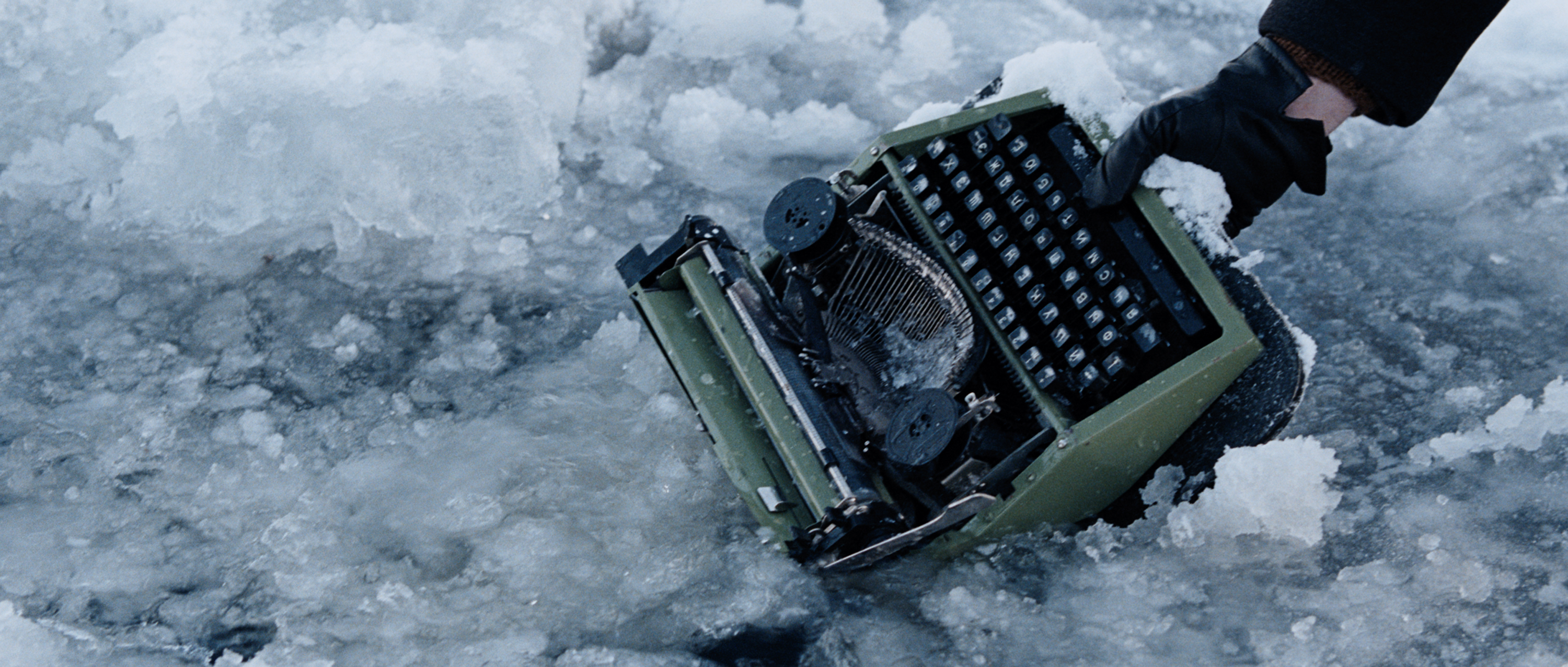
No story about men and boys  can remain neutral when it comes to the reenactment of the the myth of Oedipus. These two films are no exception, each tracing  its own Oedipal “paternal lineage.” In Ovsyanki, the Oedipal tension is barely noticeable: narrator, though baffled by his father’s literary ambitions (his old typewriter) ethnographic eccentricities and alcoholism (he died in a fiery car crash), carries on his late father’s ethnographic project and fulfills his father’s most cherished wish, death by drowning, considered a good death in the local tribal tradition. This is the kind of a resolution to the Oedipal drama that forecloses the future.

By contrast, I Will Remember, is the conventional Oedipus squared. The main protagonist has to deal with two father figures, his real mercurial father, who had spent time in the Gulag, and the surrogate one, who by hook or by crook, tries to win the affections of the boy’s mother. Both are killed by the boy: the natural father inadvertently and unintentionally, the surrogate one in what could have been a murder suicide but turned out to be just a murder. I Will Remember doubly reaffirms the natural order of generational succession and for that reason offers its viewers a promising future, even if a melodramatic one. Ovsyanky, by contrast, drowns the history of the Finnish tribe in the upper Volga in the riverrun of time, along with the narrator and his friend. Fedorchenko thus disposes of the last survivors of the endangered species still in thrall to their archetypal roots. As the Volga waters close over their heads, the endless stream of the highway traffic above keeps flowing on, and on...


Berkeley, October 2010 - December 2011
Copyright © 2011 by Grisha Freidin (gfreidin@stanford.edu)